Care Factors Associated With Sustained 15% Weight Loss at Three Years in Patients Not Taking AOMs
- Enara Health , San Mateo, CA, USA
Background
Effective obesity care requires a multifaceted approach combining behavioral, lifestyle, pharmacologic, and surgical interventions. Recent studies highlight the potential of digital and remote engagement strategies in supporting weight maintenance. This study adds to the literature by evaluating the effectiveness of a comprehensive hybrid care model that combines traditional and digital elements.
Methods
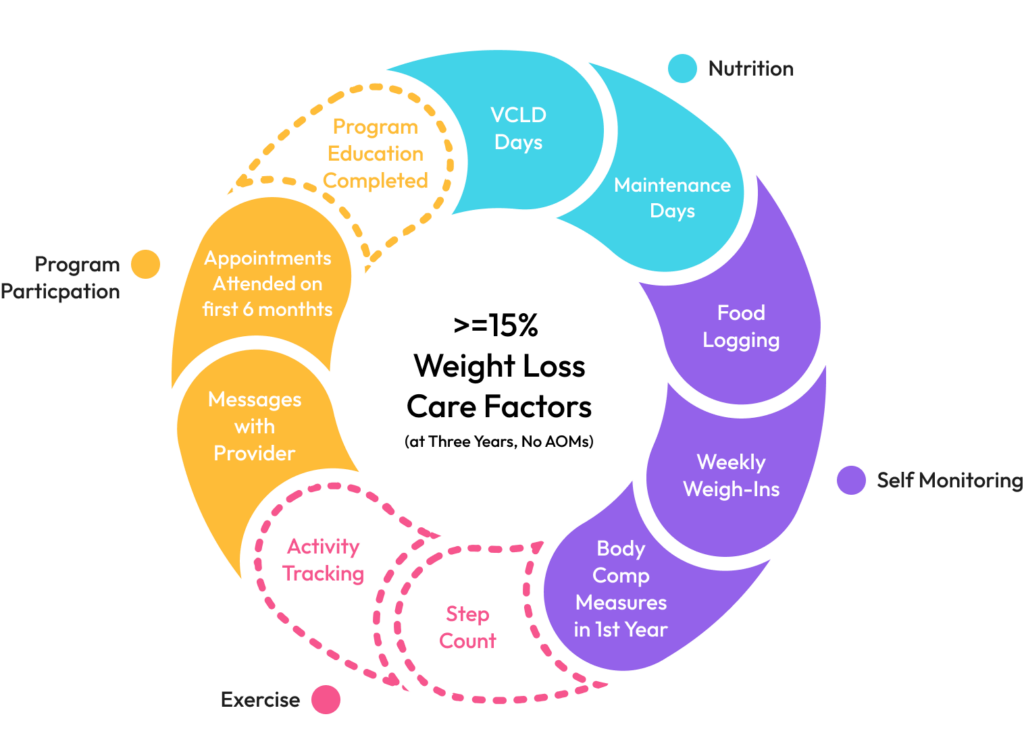
We conducted a retrospective study on adults who enrolled in a medical weight loss program and chose not to use anti-obesity medications (AOMs) over the first 36 months. High-performers were defined as participants who lost and maintained ≥15% of their starting weight. Factors evaluated included dietary approach, maintenance programming participation, monthly appointments, monthly provider text conversations, weekly food picture submissions, educational content completion, weekly weight monitoring, days using an activity tracker, and average monthly step count.
Results
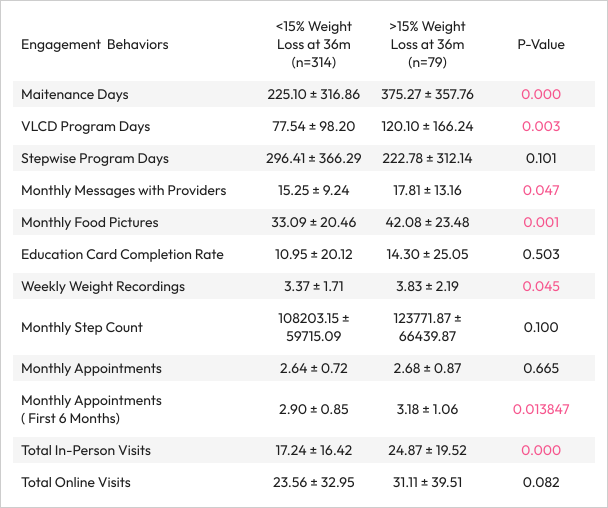
Out of 393 participants who did not use AOMs for 36 months, the average weight reduction was 8.93% ± 8.67. High achievers, representing 20.1% of participants, had significantly more monthly text conversations (17.81 vs. 15.25, p=0.04), food picture submissions (42.08 vs. 33.09, p<0.001), weekly weigh-ins (3.83 vs. 3.37, p=0.045), very low-calorie diet (VLCD) program days (120.10 vs. 77.54, p<0.001), and maintenance program days (375.27 vs. 225.10, p<0.001). There was no significant difference between high achievers and their counterparts in educational content completion, days using an activity tracker, or step count over 36 months. High achievement was linked to more frequent monthly appointments in the first 6 months (3.18 vs. 2.90, p=0.014) but not significant over 36 months.
Conclusion
Digital engagement components, such as text messaging, food logging, and weekly weight monitoring, were significantly associated with achieving and maintaining a 15% weight loss over 36 months. Traditional factors, including program type, maintenance participation, and appointment attendance but only in the first 6 months, were also associated with high achievement. Integrating remote digital engagement with traditional care elements enhances the effectiveness of obesity care programs, providing convenient tools for long-term weight management success.